A lifelong love affair
[Previously published on Substack, September 02023]
Language has always fascinated me, but I’ve never really connected it to writing. Odd, when I stop to think about it. Of course, language composes writing but writing feels different. Perhaps it’s the facet of permanence that writing offers. A formal decree of a thought rather than sending it through waves in the atmosphere to see if it is picked up.
When podcasts were still very new, I stumbled upon NPRs catalog of digitally formatted radio shows available to listen for free on their website. I had an entry level job at the time and the only work I was given was mindless and rote. A few weeks in, I figured out how to write a script in Photoshop and automated most of what I was getting paid to do, transforming my eight hour work day to just a few minutes. I had nothing but time. I listened to the entire collection of This American Life produced by Ira Glass on the company dime. Listening to these auditory stories intimately though my earbuds enclosed in my cubicle was a transformation. I didn’t know exactly what it was I loved about them, but I could not stop listening. They were honest, varied, and thoughtful. I devoured all the past episodes in just a few weeks and needed something else to fill the mind-numbing hours at work.
Enter Radiolab. Another digitally available radio show by Jad Abumrad for WNYC. It’s evolved over the years. Back then the show explored how lesser known scientific concepts showed up in the real world and I found it fascinating. It was through this show that I learned how babies develop language, almost by way of subtracting phonemes rather than adding them. The idea settled into my brain and hasn’t left. It was one of those concepts that effects the way you see the rest of the world. I’ve listened to a lot of educational podcasts since.
I really enjoy a philosophy podcast by Stephen West. I find his sense of humor is perfectly peppered with irritation. Recently, he’s dedicated some of his discussion to the philosophical implications of AI (as everyone has) and touched on large language models. It got me thinking about how one would even begin to structure a system to include all the language needed to represent the world to itself? Maybe it’s possible that eventually we’d be able to collect the language needed to classify and categorize all of the human experience of the world. Maybe.
With further thought, we run into issues. How will animals be classified? Will we reduce them to the sums of their differences from us and each other. The leathery, trunked, grays? Would Asian elephants be another entity? Leathery, trunked, brownish-grays? I wonder what differences would become evident if we put less effort into categorization at the start.
The true essence of an elephant can only be known to themselves. To us, elephants are a Wikipedia page dedicated to our (human) collected experiences with these creatures. Our knowledge is limited by our humanness. The most we can possibly know about elephants is what we are able to observe and the sum of what we can learn from each other—if! we dedicate our entire life to the study and observation of the elephants of the world. By the way, if you are a person who has done that, please send me an email about what your day is like and how you got to be such a badass. (I would like badass introduced into the vernacular of white moms turning 40, please.) What about the reverse? What would we agree should be included on the Wikipedia page of us for the elephants? What has been the experience of humans to elephants? I bet the elephant version of wikihumans wouldn’t make us look very good in the end.
We are also limited by what we desire to know or experience. Learning about elephants requires some effort for those of us who don’t have them in our backyard. We need to listen and read. Personally, I learn best by jotting down notes on index cards, a tip I picked up from Anne Lamott. Her passage on folding an index card vertically because she didn’t want it to bulge in her back pocket made me laugh out loud. Heaven forbid our ass not look perfect for everyone else. I hear ya, sister.
See? There’s one right there. “Ya” You know what I mean, but would an LLM? And, how would it distinguish from my vernacular use of “ya” meaning you or the Spanish interpretation that deals with time? “I hear time” is an incredibly different interpretation. So much of the human experience is ephemeral and/or connected to our existence in a physical place, sensing at least five ways. I just don’t think that’s possible to capture with the use of language alone.
I do see one way it might work out. Simplicity. Addition only by subtraction. Anonymity in pronouns is a good example of this. ‘They’ does not define he/she, it is just they, another. In English, “they” can even mean one or many. There is nothing concrete associated with it; therefore, no reduction can be applied to the possible qualifiers that can be assigned based on gender, most of which were ideas developed and recorded as fact by biased and perhaps otherwise influenced scientists and philosophers. If we were to use their outdated thinking to assess the likelihood of a heart attack based on gender, we’d do women a disservice. There are countless examples of things we humans thought we knew for certain that were proven incorrect or incomplete a few years down the road.
Also, cultural agreement on past and future vernacular of said culture would be necessary in order to correctly categorize the nuances between a fad expression among the youth and a tested expression adopted by the majority culture as significant. When you start thinking about language like this—in the way humans relate to it—there is no end to the amount of contributions that would need to be added in order for an LLM to experience the world even close to the way the world experiences itself.
There is opportunity to use this thinking to our advantage. There have been countless missteps on the language used in the public education on climate change. Global warming… so? What is global warming to me the individual? I feel no effect on my day if the “globe warms.” Now, I fully understand the complexity of the climate cannot be sloganized but I do believe there could have been improvements made. Maybe connect it to the temperature? People hate being too hot. The other day I was poking around on X, I am mindful of my time there these days, but it is a great dopamine hit. I follow local leaders trying to improve their neighborhoods from the inside. Jamie Littlefield is has interesting thoughts on how to build better communities with more comprehensive imagination. I love the callout on language here:
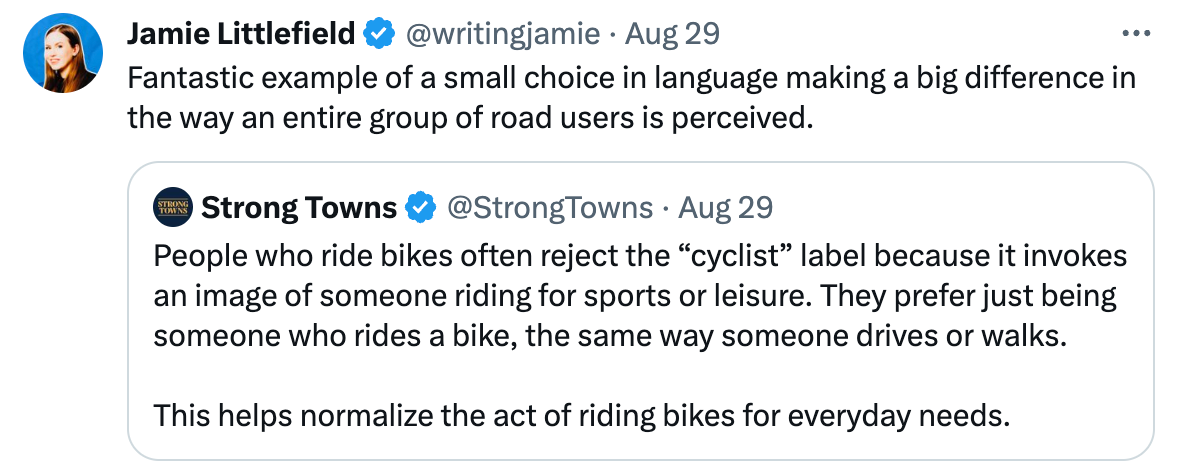
Campaigning for a “bike path” or “walking path” both improves the public’s reception to the idea and normalizes a bicycle as a practical and low-cost, low-emission mode of transportation. Somewhere along the way, the car became king and we started fighting for “cyclist lanes” instead of “safe roads.” We need to return to the idea of keeping our neighborhood livable, and we do that by saying what we want in plain language. I want a sidewalk on the street at the top of my hill so my kids can walk to school and I can go for a run with Ink safely. I could walk to the market with a cart to carry things home. I can understand how my world would change with a sidewalk. It’s salient. I’d like the church at the corner to use their large lawn to help the environment in some way. Maybe some native plants for pollinators or a vegetable garden that serves the community? That one has some fuzzy edges, more thought is needed.
All this to say, although important, our language is just a part of what we experience. You can never really capture with words the sweet, smell of earth in the early morning after a light rain. A sensation like that can only be experienced.
Remember that scene in Eat, Pray, Love? When Julia Roberts is standing in the kitchen in Italy and the scene is shot in a way that shows her shift from understanding the Italian language to experiencing the preparation of a meal in Italy. I love Ryan Murphy’s interpretation of fluency. For personal reasons, I hope that Liz had some say in it, too. It’s such a beautiful moment. Intrinsically, we know that there is something else there. More than just the words we learn to say.
 Life with ink
Leave a comment