Preaching to the choir

Recently, I watched a PBS special on the Gilded Age with my nine-year-old. I started the documentary twice before but both attempts were at night, and while I always appreciate the quality content PBS provides, this documentary was one with a mild-mannered narrator and a lot of the same images slowly zooming in and out on screen as a series of dates are read aloud. Not exactly a stimulant, if you know what I mean.
It was Saturday morning so I didn’t have anywhere I needed to be. I was up and done with my morning shenanigans before anyone else was even awake. Alongside a cup of coffee, I felt well-rested enough to give it another go. About a third of the way through, my youngest came out of his room, and as is his morning routine, drove his face into the couch cushions as he wrapped himself in the nearest blanket. (In the living room blankets are plentiful, and for some unknown reason perpetually on the floor.) I said good morning and he nodded. We sat quietly like that for a while. I continued my doodling while attentively listening to the factors at play in society at the tail end of the 1800s. After about ten minutes, he stood up and grabbed the remote. I waited to see if he’d ask before changing the program, but to my surprise, he turned on the captions and laid back down. We watched the rest of it together. After a few false starts, I made it to the end of the Gilded Age with my kid.
During the time we frame as the Gilded Age, America saw a class divide so vast it seemed as though there were two different countries here at the same time. The rich had a unique set of values and the poor were focused solely on survival. The relatively new newspaper media held a heavy influence over public opinion, corruption infected the politics, and technological progress chugged along at a breakneck pace as industrialists fought to lay the most lucrative track. The Haves of the time led lives so absurdly lavish it bordered on cruelty. The funding for the Great Vanderbilt Ball could have fed a thousand working class families for a year. I don’t know about you, but I would have a difficult time enjoying myself at a party like that. Of course, that probably means I would never have received an invite. The Vanderbilt home was only large enough to host four hundred guests, so there was intense competition to make the list. There is no worse fate for a socialite then landing at 401. The people with the time and resources to fight the rise of empires were distracted by pomp and circumstance, while the fat cats hoarded the wealth and subjugated the working class. By the time anyone thought to try and fix the economy they exploited, their worth had become their top value and the profit-saving band-aid they employed wasn’t enough to help the ailing.
Sometimes I am astonished at how closely history mirrors the present day. I know I talk about it all the time, but it feels like we should be smarter about it somehow, you know, as a people? The older I get the more resigned I am to the idea that things tend to play themselves out step by step, even if you’re limber enough to skip a couple. It’s how you protect yourself that’s critical.
My Honorary Aunt, Judy Woodruff, recently interviewed Robert Putnam about that time in history. As he explains history’s telling, the Progressive Era (that’s the next one if you’re following along) was ushered in by, not economic, but cultural change. People began to form clubs based on wide criteria like the Rotary Club, the Boy Scouts, and the NAACP, for example. The General Federation of Women Club began growing it’s numbers. Large groups of working class citizens (record numbers at the time) started banding together to improve their own lives. Their common interests spilled over into common causes. Clubs went on to form political parties to advocate for their rights. The people started utilizing their system of government to make changes to benefit themselves. This was the time of civil rights, women’s suffrage, unions and labor rights. Clubs affected change in the country and they worked from the bottom up. In the words of Mr. Putnam people found “power through organization.”
Mr. Putnam sewed a seed of hope into the end of his interview. He insisted he wasn’t a determinist about our current circumstance. He didn’t think the same thing was predetermined to happen again, but he said he knows it could happen again because it happened in the past. The people can decide to unite.
So, where are these clubs now? Since the mid-century, American club participation has been steadily declining. Some point to the media we consume as a cause, first television kept people isolated in their homes and now our devices take the place of most of our face-to-face interactions. The void in our communities has shown up in our politics. Why aren’t we all in the streets with signs? Why aren’t I in the street with a sign?… First, I wouldn’t know what to write: “Stop,” “You’re ruining it,” “You’re f*cking it all up with your lust for greed and power. You’re running things like a business because that’s how you relate to the world, but there is so much more here than just a money making enterprise. There is art. There is entropy. There are swirls of culture so complex, they create cultures inside themselves. And isn’t that beautiful?” I don’t think a sign like that would be legible from the top of the tower. Second, I think I’d feel more comfortable and more effective if I took to the streets as part of a group.
I went to support a gathering of this kind a few weeks ago at the encouragement of a friend. She heard about a show that optimized the celebration of both Valentine’s Day and Presidents’ Day, featuring letters and poems written by various POTUS + FLOTUS pairs throughout American history performed as choir arrangements. She thought I’d have fun, and as embarrassed as I am to admit, she knows me pretty well. I played hooky from school for the day (it was a review of fallacies from last semester anyway) and I headed to the local Arts Center to watch a group of people who loved to sing together. Ticket proceeds and donations collected at the show benefitted a civil law group aiding immigrants through the justice system. Presumably, the singers in the choir share a passion for both singing and human rights. Truthfully, choir music isn’t at the top of my appreciated genre list, but the performance quality was excellent. I was thrilled to see how robust the choir was. It was a sizable group with well-balanced sections. There were even enough baritones to keep each other company. I gotta tell you, I enjoyed myself at the assembly.
My favorite part of the show was the oration between songs to set up the context of each Administration. The emcee, a local political figure, shared stories about the characters of each President and what was going on in the country at the time. Most stories favored the first ladies, which is feminist bait I will fall for every time. Did you know that President Buchanan’s Acting First Lady was his niece, Harriet Lane? She was the first First Lady to promote deserving causes, like improving the living conditions for Native Americans on reservations, and funding a children’s hospital. People loved her. She has a Coast Guard ship named after her that’s still in service. The lyrics taken from her writing were about her recent conquest with true American style. He’s rich and keeps a yacht. Diva.
The words of the former Presidents and First Ladies are interesting and relatable today. Even ol’ George Washington had a few romantic words for Martha:
From your bright sparkling eyes, I was undone;
G.Wash
Rays, you have, more transparent than the sun
Imagine receiving a text like that? A far cry from the today’s presidential language.
It warms my heart that this choir exists. Here is a group of people who love being part of a choir, but for whatever reason, didn’t find what they were searching for in the lyrics of traditional choir music. Instead of giving up the art all together, the director composed the group it’s own songs using content that held meaning for them. The people still join together and sing. Demonstrating yet again, that it’s not the words that matter as much as the act of raising voices in harmony.
I’ve been to a few events at this particular arts center. I love it because it’s community-based, and the art that is displayed and performed there feels accessible to everyone. Personally, I have a pretty broad definition for art. I think of art as a kind of energetic tango between the viewer and the piece. If I had to try and nail it down, art is an intentional alteration of what is that attempts to create energetic change in the viewer. There is a lot of very fun-to-look-at art that misses the mark by my definition. I’d call that design, I think. Art includes any energetic exchanges that are non-relational (meaning sensory experiences with other beings) or non-natural (meaning sensory experiences that are caused by weather, climate, or landscape). Although there is art that can combine these experiences. I can be energetically changed by art created down the street the same as anywhere else.
One piece I love is right outside the art center’s front doors—a bus stop shaped like the word “bus.” It’s gigantic. The letters are about twice my height, shaped in black steel, and slated with strips of wood just like the bus stop benches typical of the area. The bottom of each letter forms a comfy seat for anyone waiting on the Citylink. That’s art. I think it’s the playfulness for me. It interrupts the space to say Look here! A thing we all know and recognize has been made a little more joyful! BUT!… Only because we made it more itself! The bus stop sculpture doesn’t take up much more room that an ordinary bench would and its a great landmark for people trying to find the building. It’s a celebration of city life, an appreciation for public transit. I don’t know. I like it. It speaks to me. It helps me see that space differently. There’s a little more life there because of art.
Art does not have to be flashy, or expensive to be life changing. Sometimes a small piece framed behind the register in a coffee shop, a lyric borrowed from Old Abe, or a bus stop sculpture will catch you in the exact right mood, and zap you like a lightening bolt. This! I…love…this. Or an artist expresses some kind of struggle or oppression you haven’t experienced first hand and through their art you are able to feel the heaviness with them. You volunteer to hold a portion of the weight. You can be forever changed by a piece of art. You can walk into a museum, catch sight of an energetic piece, and never again will you live the same life you were living just a moment before. There is a lot of power in a moment like that. It’s beautiful if you have a group to share it with.
I think this club is on to something by creating their own idea of what a choir can be. A shared love of music is where they found meaningful connection. They found a way to unite with each other, when it is so easy to focus on our divides. There are ideas in society that seem to create cavernous gaps between us, but we have so many more connections. For example, we can all relate to a guy living in the late 1700s who had a stressful job and loved his wife. We can make his words meaningful. We can set them to music.
That’s what I think will save us, art and community. I am grateful those choir members found each other and created their own community, united by a shared love of music and brightly colored blazers. I’m grateful they had the courage to share what they love with the rest of us. Then they passed around a basket and collected change for the world they want to see. Respect.
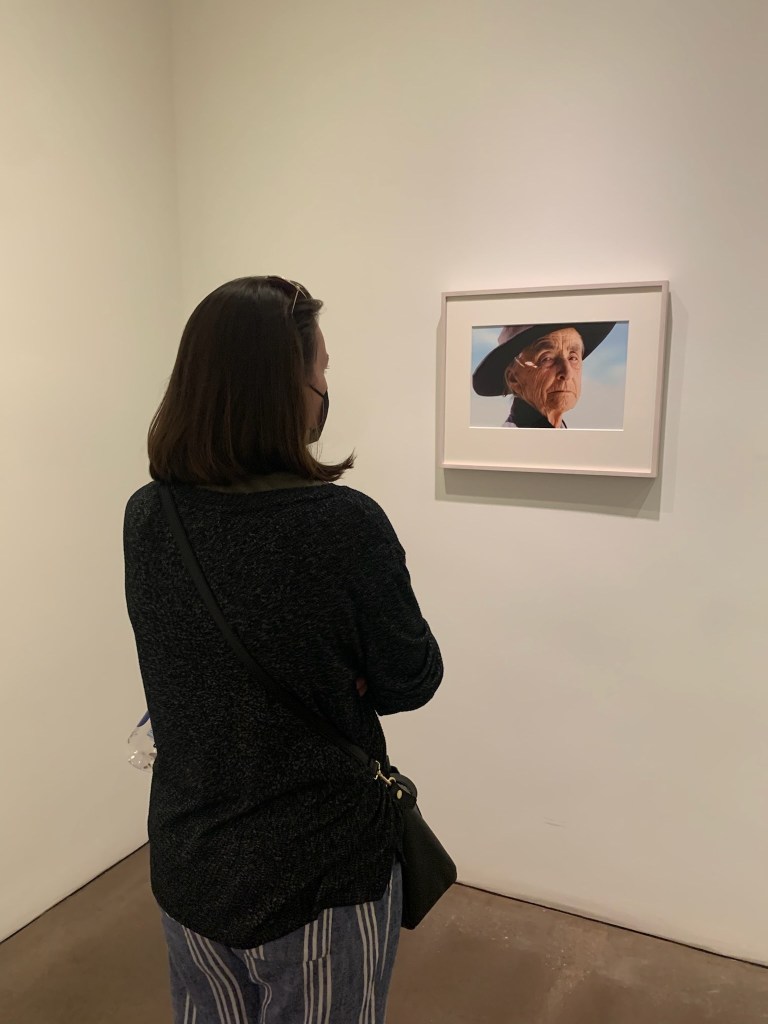
The Georgia O’Keefe Museum in Sante Fe, New Mexico.
Portrait by Malcom Varon
In this moment, I could hear Georgia’s soul speaking to me through her image. It was a gritty whisper… “Do it.”
 Life with ink
Leave a comment